For a self-professed travel blogger (even if the posts have been sparse), COVID-19 has wreaked havoc on the travel-bug cruise ship. (Many would argue that it’s the travel fuelling the virus, but sidestepping that.) Let alone taking trips, confining oneself to the house with moribund news of rising cases and deaths globally only descends a pall of gloom. After a week in exile, I decided to rack my brains to think of a place I may have not written about. Honestly, not much thought was needed for I instantly found myself transported to the Ghats of the Ganga in Varanasi.
I remember leaving for a weekend trip, when a colleague callously called Varanasi, a city that celebrates death. For a moment, that statement abhorred me. A city visited by many Hindus to complete the last rites of the loved ones no doubt, but it cannot be called one that celebrates it. Can it? Perhaps, that’s why amid all the news feed on misery, suffering and death tolls, I was reminded of Benaras (a name the locals continue to call it). It is in some sense the final journey and destination for many.


The very word Kashi (yet another name for the city) has an aura, an enigma. May be that’s why no one name can capture the essence of this city. Having lived in Damascus, Syria, the oldest living city in the world, visiting Kashi (also celebrated as one of the oldest inhabited cities) was more than tourism, it was a pilgrimage in time. I could not wait to immerse myself in the intoxicating elixir of different antiquity yet again; the city of Ghats, temples, street food and history sprinkled casually in every narrow alley. Kashi beckoned like never before.
Many descriptions of Kashi speak of its surreal immortality. Indeed. It manifests in the local air with its scent of history, pungency of culture and tang of time. The ambient sound is not the usual noise of vehicles and modern gadgets, but of devotion, happy chaos and silence of breathing humanity from time immemorial. In the collage that unfolds in front of you, against the backdrop of faded edifices of varying timelines, are a people that you cannot categorise. The saffron-robed sadhus, the naked Aghories, the unvarying urban folk, the youth caught somewhere in between and the not-to-miss brightly-attired foreign tourists trying to pass off as locals. Banaras is an assault on all your senses and one that permeates every inch of your skin.


The day started with a customary drive around the city to understand the lay of the land. Perhaps, we should all make travel plans only after checking the political activity calendars, for I managed to land up on a day when very senior politicians were holding rallies in the city. So most of the forenoon was spent in traffic jams. When a car hasn’t moved an inch in the last thirty minutes, you expect those stuck to blow horns, if not expletives. But to my surprise, the public seemed to take it in its stride. As I abandoned the car, I heard a man on a bullock cart animatedly say on the phone, “I guess, I’ll tie them at the next turn and walk home.” People were talking, snacking and indulging in the traffic status Chinese whispers. Not a single horn was to be heard. Locals seemed to be living the ‘when life gives you lemons, make lemonade’ adage. This was perhaps my first brush with the spirit of Benaras. We all tend to hyperventilate for things so trivial, that we often start losing the bigger picture. For where the pyre never goes out of flame, the fragility of existence and the gift of life is far too precious, I guess.
Dissolved in the air of the city is the aroma of the famous street food. With a long list of where to eat, I dashed from one place to another to try the kachori sabzi, dahi chutney gol gappe, tamatar chaat, malaio and rabri jalebi. Yes, it’s a long list, each more sinful than the other. From deep fried delicacies to the overindulgent milk preparations, you are left wondering whether the ‘richness’ of culture also gets reflected in the gastronomical preferences of the people. Is it because that it is the city of Lord Shiva, an indulgent god himself, that Thandai (a milk based drink) is sold with the pinch of Bhang (cannabis preparation) on the streets? Or is it that culturally a city of pilgrims and traders, Kashi has always had an influx of visitors, and for whom the city is ever ready with an elaborate spread befitting the ‘Athiti Devo Bhav’ mantra. Or simply, does this otherwise extravagant buffet serve as comfort food for the many who haunt it in their darkest and most difficult times? Perhaps, it depends on what brings you to Kashi.


Though not a walker’s paradise, Benaras is still a walker’s delight. The gullies are narrow, but colourful; dirty, but welcoming; and quaint, but lively. While basic itinerary included the house where Tulsidas wrote the Ramayana, the birthplace of Rani Laxmi Bai and the Pahalwan Akhadas, one let the roads lead the way. There is a charm in not knowing the destination always; especially when you are in a city that at no point reveals herself completely. Every bylane is marked by temples, big or small. Households don’t have doors that seem to shut. With barely space for two to walk side by side and houses stacked next to each other, you find yourself jostling for space, not just on the pathway but also in your mind to comprehend the reality in front of you.


The cobbled pathway is shared equally by humans and other mortals, especially cows and dogs. But unlike our city upbringing of maintaining distance, you will find the locals engage with the animals. They pat, feed and even talk to it. Stop at any tea stall, and the locals will happily engage with you as well. They have strong opinions about everything, but feel most strongly about their city. Each is a pundit in his/her own right and believes to know the truth about the universe, which of course stems from knowing the truth about Benaras. For some Kashi is a geometric center of the universe, while for others it a flying vessel floating in time and space. Such is their pride in their city and its heritage. Who are these people you wonder? Are they the real treasure of this city? For what is a city’s character if not the collective of its residents.


Another defining character is the river that has flowed through this city for centuries. In Kashi, all roads lead to the mighty river Ganga. Calm and serene, it is an all-seeing and permanent fixture. As Ganga takes in the hustle-bustle of its banks, the offerings of its devotees and its own commercialization at times, it evokes comfort in the idea of confession and hope that everything will be alright. Perhaps, that’s the birth of notion of the ‘holy dip’ in the Ganga is said to purge you of your sins. The mystery of its timelessness and eternal continuity makes it the crowning jewel of Benaras.
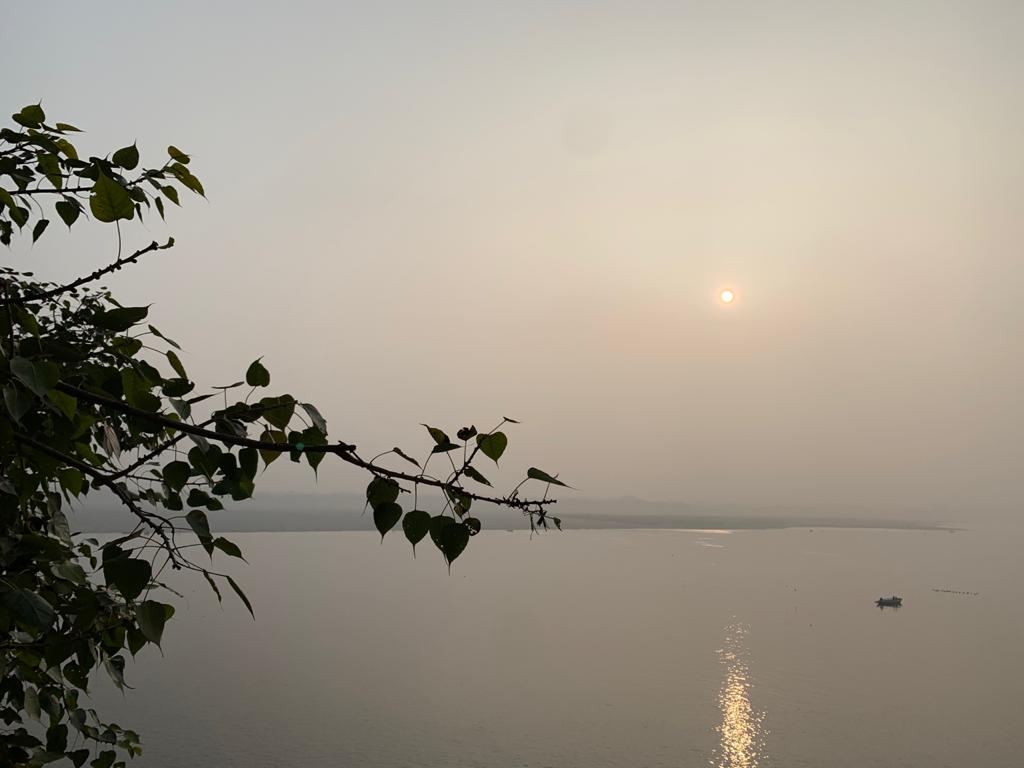
It is easy to get lost in the bylanes (and I mean more than literally). The mindboggling complexity of the place warrants that you extricate yourself and take a voyage on the outside and let the city bustle beyond your horizon. Simply put: a boat ride in the evening, around the time of Ganga Aarti. As I embarked on a journey, I felt like I was in a movie theatre, except here it was I who was moving rather than the reel, and the story of Kashi unfolded in front of me. Perhaps, the most charming phenomenon of Kashi are its Ghats (steps leading to the river) where the sea of humanity merges with the river. In one montage, there is the stillness of decorated Ghats and unique architectural designs, the commotion of activity and the slow-moving jigsaw of boats docked. This captures Kashi – it is static and unchanging, while nurturing the dynamic, for it knows the power and responsibility of its own immortality.


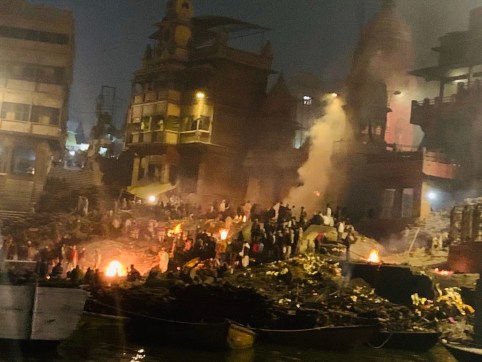
As the boat moved from one Ghat to another, I learned names such as Ahilyabai Ghat, Dasaswamedh Ghat, Harish Chandra Ghat, Jain Ghat, Manikarnika Ghat and Assi Ghat. Each with its own story, myth and fable, I realized that Benaras is no pilgrim town alone. It stands as much for religion, as it does for mythology or history. Whereas the Manikarnika and Harish Chandra Ghat have pyres burning all day and all night, Dasaswamedh Ghat, the main Ghat of the city, hosts the Ganga Aarti celebrating the mighty and resplendent river that is the source of life of the city. Other Ghats either honour the contributions of royalty or celebrate mythological characters. So, much like the many names of the city itself, the many names of the Ghats leave you wondering what Kashi really is; an anachronism or a mystery yet to be deciphered.


A must visit is the ancient Kashi Vishwanath Temple. But before entering the sacred grounds, there is the commerce of faith, where everything, from flowers, sweets, Ganga Jal (holy water) to Pooja Thalis (prayer baskets), is on sale. If you survive that, inside, the temple will uplift your spirits. While the pious may prostrate and be overcome, even the agnostic will be moved by the spirit of peace, tranquillity and the sheer power of enduring faith. The Gyanvapi Mosque adjoining the complex defies any misconceived notion a monolithic Benaras. No one idea, belief, faith or memoire can define Kashi!
As I was leaving the city, I wondered if I can attempt to describe Kashi in one sentence, like my colleague did. Replete with every aspect of India’s composite culture, for it is one city that encapsulates time. No, traveling to Kashi is not time travel. It is a city of the future for it restores one’s faith in humanity that we have and shall continue to exist. A message and emotion that rings closer home today in times of the crisis that the world is reeling under. So, for me, Kashi is not a city that celebrates death, but one that recognizing its finality, and celebrates life like no other.


 PUJYA PRIYADARSHNI
Leave a reply to Prabhath m babu Cancel reply