If I were to look back to try and trace the moment when we decided to go to the Kumbh this year, my memory would fail me. It was clearly my decision, given my parents had been through the ritual in their lifetimes already. So, the next question that arose was ‘why’. Why did I want to go to the Kumbh? No, it wasn’t out of the pious emotion of wanting to purge oneself of one’s sins. Nor was it the years of socialization that made one feel impelled to traverse the distance.
Simply, it was the tourist in me. The media blitzkrieg around the 7-week long extravaganza, with due credit to the government, had managed to create a hype around the Kumbh that made it an irresistible attraction of 2019. The world’s largest congregation of humans with an expected 150 million visitors, surely makes the cut for the ‘experiences-before-you-die’ bucket-list!

With improved connectivity, a weekend getaway to the Kumbh is both feasible and affordable. Excited and apprehensive, I expected crowds and chaos in tandem with religious fervor setting the ambient tone and tenor. I mentally prepared myself for time travel to a religious past. But, as the Kumbh unfolded before me, the dip in the Sangam was only a by-product of a journey into the microcosm of India (perhaps 10% of the population does qualify statistically as well). Yes, it is a Hindu Mela at the newly christened Prayagraj (erstwhile Allahabad). But, it is perhaps the melting of what it means to be Indian.
As we navigated through the narrow streets of Prayagraj towards Sangam, we found ourselves being introduced to a town caught in a time warp with dilapidated and decrepit buildings juxtaposed against vibrantly colored graffiti. It is reminiscent of the tradition versus modernity continuum, where we find an aspirational India caught in the web of superficial associations of development. The recent name change only adds to the confusion of progress with both competing for relevance and identity. Crumbling shops, dirty bylanes and abject poverty is blurred with the glitzy hoardings, new brands and ubiquitous smartphones. The imposing bridge on the Yamuna connecting the city with the Ghats on the other seemed to mock at the condition of the city left behind.
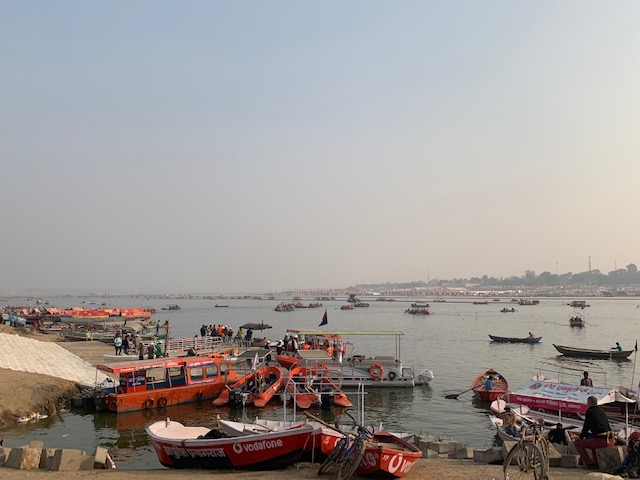
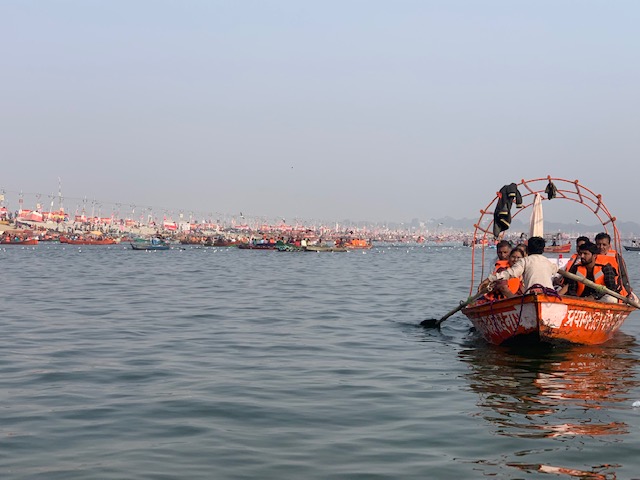
First things first, we took a boat ride for the holy dip. A riot of colors from the word go, the decorative boats and multicolored flags, buoys and platforms make a refreshing montage. Bhajans playing through the speakers permeate the landscape almost as if they are being sung by none other than the river itself. Adding to the hustle-bustle of the place are the elegant seagulls that throng the venue in thousands. Fed by boatmen and visitors alike, the interaction is a visual treat for the spectators!


With no permanent structure, the areas for the dip are demarcated by boats and platforms. There is no easy way of saying this…THE WATER IS VERY COLD! The tip of your toe will send alert signals throughout your body for the onslaught of the chilly waters you are about encounter. Overcome the fear and take the plunge. I assure you that you will emerge rejuvenated. Pious or not, the energy of the place is contagious. There is something about communal activity that contributes to a sense of belonging. Simple example: you will end up talking to your fellow passengers on the way back in the boat, even if silence had marked your onward journey.


Prayagraj…Allahabad…Triveni Sangam! It is here that the mighty Ganga, Yamuna and mystical Saraswati meet and together make the formidable Ganges that traces its route all the way into the Bay of Bengal. The India-Bharat (or the modern versus traditional) divide is physically manifested at the Sangam where the colors of the Ganga and Yamuna are starkly different; the former being considerably lighter than the latter. At the point of the holy dip i.e. the Sangam Ghat, the divide is perhaps most visible.
Soon, the distinction disappears and the river is one. The merger epitomizes what G.S. Ghurye had famously called the ‘Indianization of modernity’ instead of ‘modernization of tradition’, in case of India. How so? As we headed to see the Akshayavat (sacred fig tree) and Saraswati Kund, housed in the Akbar Quila (Fort), we walked through the crowded streets bustling with street vendors selling yantra, tantra and fortunes, distributers of free Bhagavad Gitas and other religious texts, devout mendicants and children begging for food. What will intrigue you is the narrative used by them – they call out to you for your work stress, pose for selfies and make pseudo-scientific claims – to appeal to your rational-modern identity. From Sadhu Babas relishing ice-creams to a mendicant dressed like Goddess Kali posing for a selfie, it is the real Sangam of tradition and modernity that is India.


Much like the river, here the devotees and tourists alike immerse themselves in a sea of humanity that does not distinguish one from another. Even in this ostensibly religious atmosphere, it is the air of entrepreneurship, tourism and heterogeneity that marks Mela. Walk through the small lanes and you will be surprised to hear the diversity of the Indian languages, attire and appearance. A discerning eye will help you notice the Safai Karamcharis (cleaner) arduously cleaning the premises and the many young Swachhagrahis spreading the message of a clean river under the Namami Gange project. The miracle lies in inculcating a sense of civic responsibility in the diverse groups that throng this spectacle.


Beyond the busy main street lie the Akharas. Here, the diversity is perhaps most palpable. With each Akhara having its own patronage, rules and rituals, the meaning of life, joy and salvation find different interpretations. But, as an Amul ad succinctly put it “Kumbh One, Kumbh All’ is the motto as these Akharas have their doors open to all. Walk through them, interact with the Sadhus and participate in sermons in this city of tents. The Kumbh is home to many firsts and initiatives. The recent landmark being the Kinnar Akhada’s bathing ritual at the Sangam marking a first for transgenders across India. This year the Kumbh also goes international (besides the expected foreign tourist footfall of about 1 million) with delegates from the Pravasi Bharati Divas (convened at Varanasi) being brought to Sangam as part of the larger effort to trace their Indian roots. Here, don’t miss the arena built around the flags of the 75 participating nations and the ‘selfie point’ with KUMBH 2019 as the backdrop. Indeed it is the spirit of inclusion and camaraderie that form the bedrock of the festivities that are unfolding in this city-town of Prayagraj.


So can any one community or group appropriate the Kumbh? Definitely, not. It belongs as much to a devotee as it does to the Swachhagrahi, the migrants from nearby towns trying to augment incomes, the curious tourists, the policemen, the NDRF and the Indian diaspora. Kumbh is the sangam of Bharat and India, of modernity and tradition and of course, of Ganga and Yamuna. It is this fabric of Indian society that is integrative, secular and tolerant that makes the tagline ‘Divya Kumbh, Bhavya Kumbh’ apt and defining.


 PUJYA PRIYADARSHNI
Leave a reply to Sangeeta Cancel reply