Should one even attempt writing about a work trip? Especially one to Indonesia that does not include Bali in its itinerary! Yes, work trips can be dull since the reigns of control for planning the trip are snatched and vested with the work travel desk. So, with rather low expectations, I set out for a short trip to Jakarta.
Today, an airport is like the much-feared post-apocalyptic world featured in dystopian cinema. Masks all around and a general sense of weariness. With the corona virus scare, airports today are dismal; they seem to have transformed from gateways for getaways to moribund chambers selling tickets to hell. Delhi or the transit airport of Singapore; each was equally ominous. Yet another setback right at the beginning of the journey.
As one boarded Garuda airlines from Singapore, one was greeted with folded hands (similar to the gesture of Namaste), except the airline staff politely bowed saying ‘Salam Alaykum’. Instinctively, I found myself folding my hands but instead of saying namaste was at a loss of words. For a moment my senses seemed to betray my trained social response. This encounter really set the tone for Indonesia; familiar yet alien, almost known yet so many unknowns.
After a 12-hour journey, as one stepped outside on the curb of Jakarta airport, first to come off was the mask! The smell of fresh but humid air, distinctly characteristic of proximity to a water body, soothed the lungs. A busy street, and indeed a busy city, beckoned. The drive from the airport to the city centre is usually a good barometer to test the diversity of the landscape the city has to offer. With construction activity around, the footpaths populated by greenery on either side promised a mix of Delhi and Mumbai. Multi-storied buildings, which seemed mostly to be residential complexes, suddenly disappeared as modern skyscrapers began their blitzkrieg. With shiny glass buildings and international brands hoardings, parts of Jakarta are indistinguishable from the streets of Singapore or Dubai. The uniformity makes you question mankind’s march towards inglorious architecture. But almost as if to disrupt your thought, in the heart of the city, you’ll suddenly find your car window view blocked by swarms of bikes that whisk past with colourfully attired riders, with designs akin to Indian prints. This was the second flavour of cultural proximity.
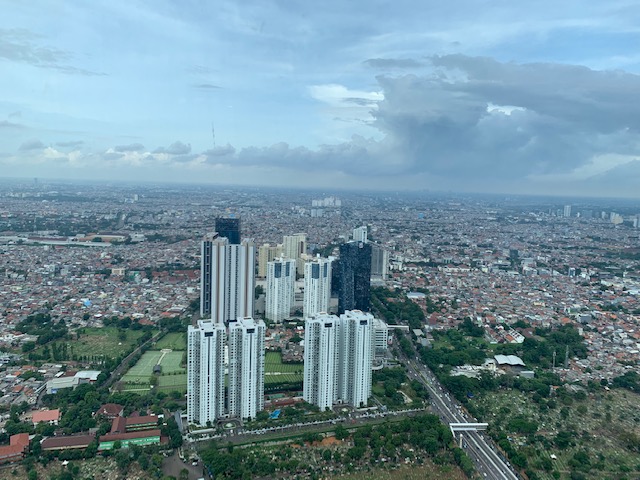
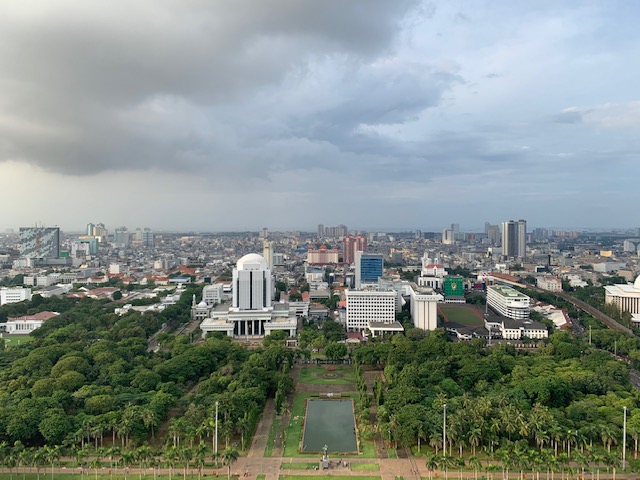
While the days were packed in back-to-back meetings, we tried to steal the joys of tourism in the evenings. First, one headed to Monas, the national monument in the heart of the city, built to celebrate Indonesia’s freedom struggle. The imposing structure, with its marble façade, has a nice complex with murals celebrating Indonesian history and pride. Do make a trip to the observation deck for a breath-taking view of the city spread across, seemingly merging with the horizon.


Continuing the patriotic fervour, next we went to the Istiqlal Mosque, which much like Monas, celebrates Indonesia’s independence (istiqlal) in 1949. The five-story building, symbolizing the five pillars of Sunni Islam, was designed by a Christian artist. It’s grand layout, imposing walls, and modern metallic finish seem characteristic of Indonesian society, one that is large enough to be daunting, but accommodating enough to lend enough space to everyone. The gates of the mosque are open for all, irrespective of gender, race or religion. It was perhaps most palpable in the sense of pride with which the Grand Imam proclaimed that the mosque is home to regular Inter-faith Dialogues.
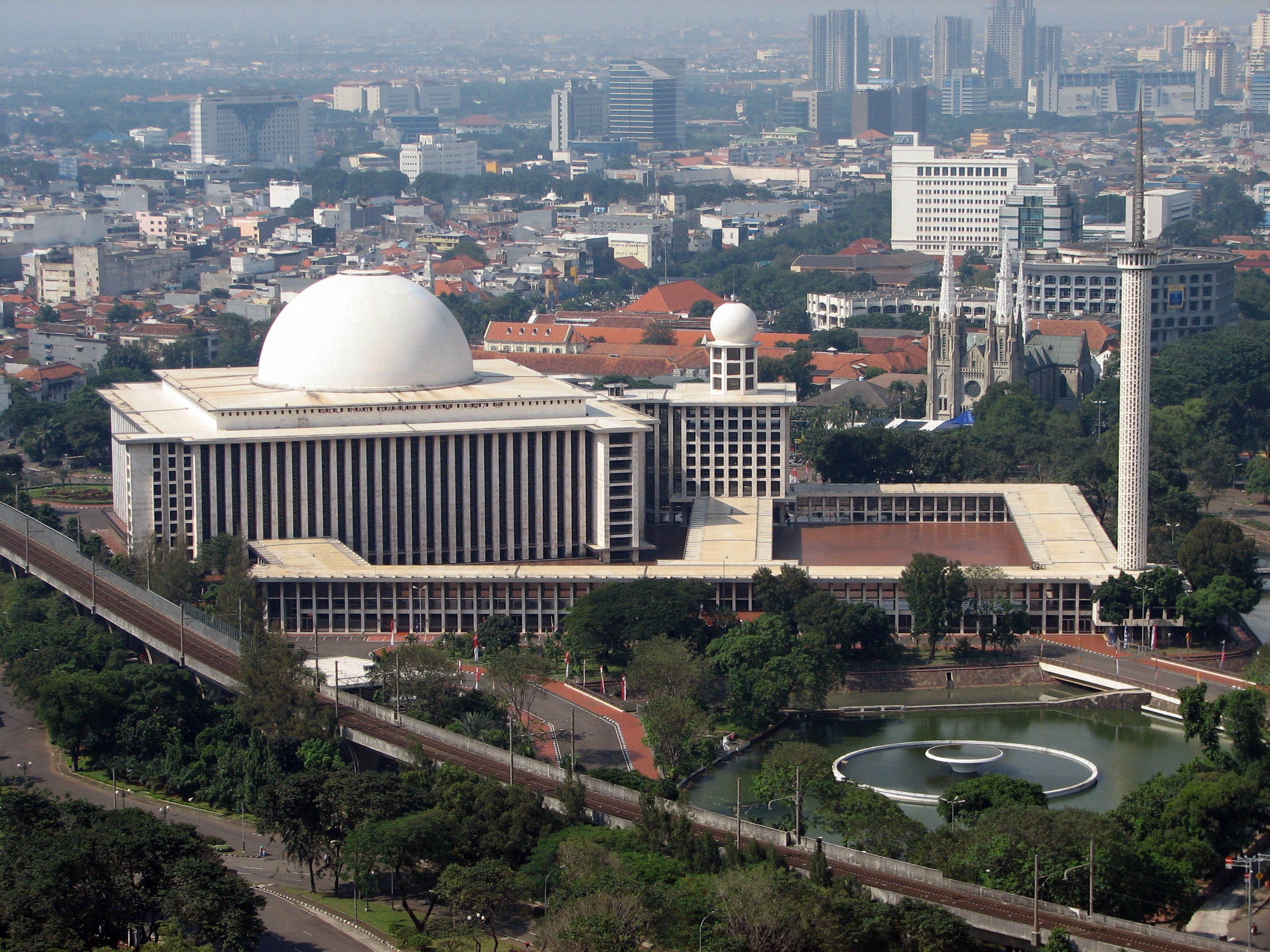
Source: https://upload.wikimedia.org/wikipedia/commons/d/de/Mosque-IMG_3537.JPG
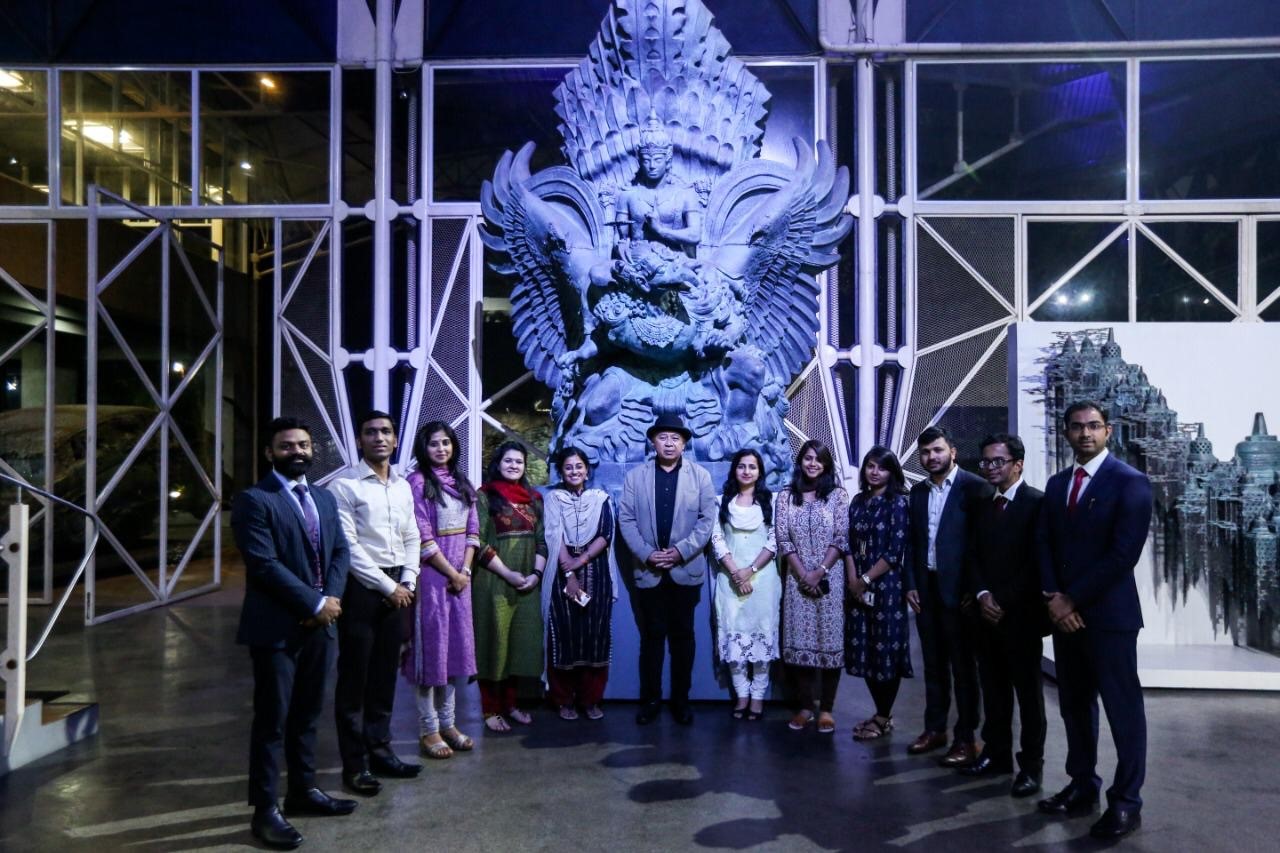
Close to the same complex, on a busy crossroads, is the famous Arujna Wijaya chariot statue. One of the many symbols of our intertwined cultural history, Ramayana and Mahabharat form an inextricable part of Indonesian society. The beauty lies as much in the linkage as it does in the sense of ownership of these fables among the locals. Even the pantheon of Hindu gods a find a place in the collective social psyche. It is therefore no surprise that Lord Ganesha is printed on the Indonesian Rupiah.

As the days behind closed doors got longer, our evening outings became shorter and more focussed on food. Jakarta is big on malls; every major road is inevitably marked by malls on either side, including food courts and gourmet restaurants. While in Jakarta, do try the Nasi Goreng and Satay (vegetarians beware for you might have to live off fruits and desserts)! Another must try is the local coffee. Whether hot or cold, shake or jelly based, the coffee preparation did not disappoint. Connoisseurs may indulge their taste buds and try the rather expensive Luwak coffee. A colleague from South India pointed out that Indonesian cuisine is well within the realm of imagination of the south Indian palate; again familiar yet distinct.


The surprise element during the visit was a day trip to West Java. The city of Bandung’s claim to fame is that it hosted the Asia Africa Conference of 1955, where world leaders from the two continents come together and laid the foundation for the Non-Aligned Movement. In this quaint little town, the conference Museum is a must visit. Walk through the haloed halls where destiny of future partnerships was crafted and which ultimately shaped the later half of the 20th century. It is not surprising that it was Indonesia, a Muslim majority nation, most well-known for its Buddhist Borobudur temple and ‘Hindu’ Bali, played host to a conference that had tolerance and peaceful co-existence as its underlying principle.


Every trip has its one highlight that leaves an indelible mark. For me, it was the evening performance at Saung Angklung Udjo (SAU), about half an hour away from Bandung. Angklung is an Indonesian traditional musical instrument made of bamboo and SAU is an art studio that preserves, curates and propagates Indonesian culture. The performance was replete with a flavour of different provinces, and showcased Helaran (harvest celebrations), the Wayang Golek (wooden puppet) narrating the story of Ramayana, traditional dance and music. The most enjoyable was the Anklung interactive session where we tried our hand at the instrument. The evening ended in the symphony of participation by the audience and culminated with a dance with young performers. In our entire stay this was when we became one with the locals.


Last, but not the least, was the visit to the NuArt Sculpture Park and Gallery. Nyoman Nuarta, a Padam Shri awardee, is a modern artist and activist whose work has socio-cultural underpinnings. He is credited with weaving Hindu gods and civilizational exchange with India into the Indonesian cultural narrative. His famous works include Garuda Wisnu Kencana (GWK) and the Arjuna Wijaya Chariot statue. One had the privilege of interacting with him; an unassuming man, he personified the potential of individual personalities in shaping ties between two cultures, people and nations!


As one walked the streets of Jakarta on the last night, walking past small carts and street vendors selling everything from local delicacies to cheap cigarettes, I found myself questioning whether the city really captured the essence of Indonesia. It is easy to write off Jakarta as a just any other city. A city of high rises, malls and mundane metropolitan life. Perhaps, the allure of Bali or pious promise of Borobudur may make one sceptical. But to me, Jakarta represented what any modern city ought to be. It embraces globalization of markets, people and ideas, without compromising on its culture and identity. Yes, the young in this capital may be found binging on McDonald’s but they would do so in their coloured Batik, while casually discussing how Lord Krishna is their President’s favourite superhero with an eye on the clock for their Namaaz time. It is truly a society that has matured to distinguish between religion, lifestyle and culture; where each compliments the other. For a world fast reeling towards what has been portentously called the ‘clash of civilizations’, perhaps Indonesia can offer lessons in merits of a syncretic culture leading to ‘Bhinneka Tunggal Ika’ (unity in diversity) for the 21st century.


 PUJYA PRIYADARSHNI

Leave a comment